Best Oreo Cheesecake Recipe (Ultra Creamy & No-Fail Guide)
The Ultimate Guide for a Perfect, Creamy Result
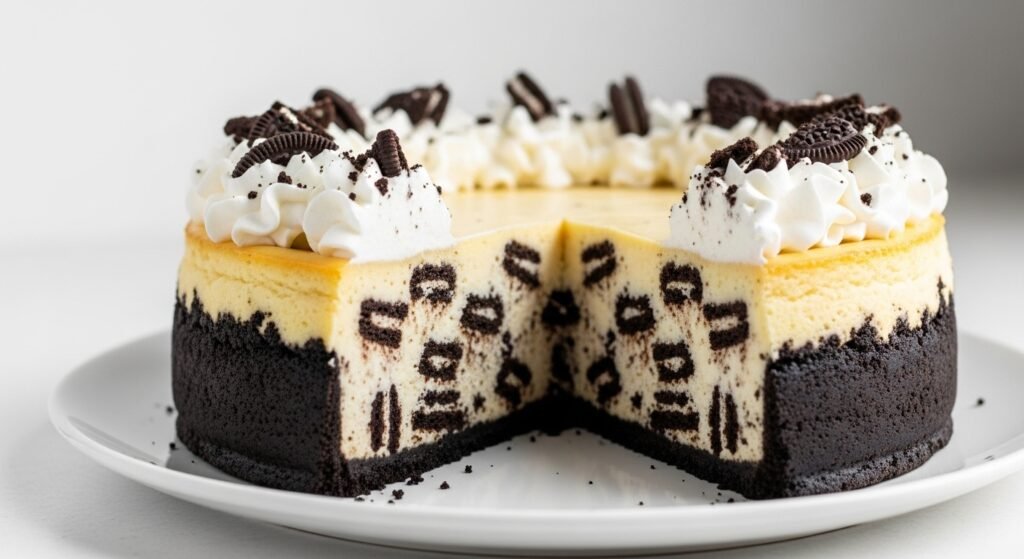
Most Oreo cheesecake recipes fail for one simple reason: people either overmix the batter, underbake the cheesecake, or overload it with Oreos until the texture collapses. A real Oreo cheesecake is creamy, rich, smooth, and structurally solid. You don’t need complicated baking tricks — you just need to understand the technique, the temperature, and the ratio of the core ingredients.
This guide gives you a complete, brutally clear breakdown of the correct Oreo cheesecake recipe, including technique, science, common mistakes, and variations that actually work without ruining the structure.
What Makes a Perfect Oreo Cheesecake?
A great Oreo cheesecake depends on four things:
- A firm Oreo crust – not crumbly, not greasy.
- A smooth cream cheese filling – no lumps, no air bubbles.
- Low and slow baking – the only way to prevent cracks.
- Proper cooling – rushing this step destroys the texture.
If you get these four right, you’ll end up with a cheesecake that cuts clean, stays creamy, and has that true Oreo flavor running through every bite.
Ingredients You Need
For the Oreo crust
24–26 Oreo cookies
5 tbsp melted butter
For the cheesecake filling
3 cups (about 680g) full-fat cream cheese
1 cup granulated sugar
½ cup sour cream
⅓ cup heavy cream
3 large eggs
1 tbsp cornstarch or 1½ tbsp flour
1½ tsp vanilla extract
12–14 chopped Oreo cookies
Optional toppings
Whipped cream
Extra crushed Oreos
Use full-fat cream cheese — low-fat versions ruin the texture and cause cracking.
Step-by-Step Oreo Cheesecake Recipe
1. Make the Oreo crust
Blend the Oreo cookies (cream included) until fine.
Add melted butter and mix until the texture resembles wet sand.
Press firmly into the bottom of a springform pan.
Important: Don’t press too hard — an overly compact crust becomes rock-solid after baking.
Bake the crust for 8–10 minutes at 170°C (340°F).
Let it cool.
2. Prepare the cheesecake batter
Beat the cream cheese until smooth — around 2 minutes.
Add sugar and beat again until fully combined.
Do not whip aggressively.
You’re mixing, not aerating. Air bubbles cause cracks.
Add sour cream, heavy cream, vanilla, and cornstarch.
Mix gently until smooth.
Add eggs one at a time, mixing slowly each time.
Fold chopped Oreos in at the end.
Avoid breaking them too much — large chunks give better texture.
3. Pour and prep for baking
Pour the batter into the cooled crust.
Tap the pan gently to release air bubbles.
4. Bake the cheesecake
Bake at 150°C (300°F) for 60–75 minutes.
Correct doneness test:
The center should still jiggle slightly — not liquid, not fully set.
Do not bake until solid. That guarantees cracks.
5. Cooling process
Turn off the oven.
Leave the cheesecake inside with the door slightly open for 1 hour.
This prevents sudden temperature change.
Then cool at room temperature for another hour.
Then refrigerate for at least 6 hours — overnight is ideal.
Do not slice early. Warm cheesecake looks set on the outside but collapses on the inside.
Why This Oreo Cheesecake Recipe Works
Cream cheese + sour cream + heavy cream = perfect structure
Sour cream adds tang and smoothness.
Heavy cream adds richness and softness.
The combination creates a dense but creamy texture.
Cornstarch reduces cracking
It stabilizes the batter without making it cakey.
Low temperature prevents overbaking
Cheesecake hates high heat. Low and slow = even cooking.
Gradual cooling prevents structural collapse
The proteins set evenly when cooled slowly. Sudden cooling = cracks.
Chopped Oreos inside the batter add texture
Whole chunks ensure every slice has real Oreo pieces.
Common Mistakes and How to Avoid Them
1. Overmixing the batter
This adds air → leads to cracks.
Mix only until combined.
2. Using low-fat dairy
It makes the cheesecake watery and unstable.
3. Baking at high temperature
This causes the edges to puff and split.
4. Not using room-temperature cream cheese
Cold cream cheese = lumps.
Lumps = uneven texture.
5. Skipping the cooling steps
A cheesecake needs time to set.
Rushing ruins it.
6. Adding too many Oreos
More is not better. Too many cookie chunks make the batter collapse.
Variations That Actually Work Without Ruining the Texture
1. No-bake Oreo cheesecake
Skip eggs and baking.
Use whipped cream + cream cheese + gelatin.
Texture is lighter but not classic.
2. Chocolate Oreo cheesecake
Replace ¼ cup sugar with cocoa powder.
Add melted chocolate to the batter.
Rich, dense, and dessert-shop style.
3. Mini Oreo cheesecakes
Bake in muffin tins 18–20 minutes.
Perfect for parties.
4. Oreo cheesecake bars
Press crust into a rectangular tray.
Bake the batter thinner.
Easier slicing.
5. Layered Oreo cheesecake
Add crushed Oreos between batter layers.
Gives stronger cookie taste.
Tips for the Best Texture and Flavor
Use full-fat cream cheese only.
Mix on LOW speed.
Always use room-temperature ingredients.
Wrap the springform pan tightly if using a water bath.
Don’t open the oven in the first 45 minutes.
Refrigerate overnight for best texture.
Use a hot knife for clean slices.
Crush Oreos lightly for the batter — not into powder.
These small details create a professional bakery-quality cheesecake.
How to Serve Oreo Cheesecake Properly
Serve chilled — it improves firmness and flavor.
Add whipped cream right before serving to prevent sinking.
Dust with crushed Oreos for texture.
Optional drizzle:
Melted chocolate
Chocolate ganache
White chocolate drizzle
Don’t overload with toppings — Oreo cheesecake is already rich.
Storage Instructions
Refrigerator
Keeps 4–5 days in an airtight container.
Freezer
Keeps 1–2 months.
Wrap slices tightly in plastic + foil.
Thaw in the fridge for 5–6 hours.
Do not thaw at room temperature — the texture becomes mushy.
Frequently Asked Questions
Can I make it without a springform pan?
Yes, but removing it cleanly is harder. Springform pans are ideal.
Can I reduce sugar?
Yes. Oreo cookies are already sweet.
Cut up to 20% sugar without affecting texture.
Can I skip sour cream?
You can replace with yogurt, but the texture becomes slightly softer.
Why did my cheesecake crack?
Overmixing, too much heat, or cooling too fast.
How do I know it’s done?
The center should wobble slightly like jello — that’s perfect.
Can I add Oreo cream into the batter?
No — it makes the batter overly sweet and unstable.
Conclusion
This Oreo cheesecake recipe gives you a perfectly creamy, rich, and balanced result without complications or unnecessary steps. Master the technique — low temperature, slow cooling, gentle mixing — and you get a professional-level cheesecake every time. It’s simple, structured, and gives consistent results whether you’re baking for a party, a restaurant-style dessert, or just because you want something indulgent.